








28 October 1918 : Independence Day of Czechoslovakia
The Independence Day of Czechoslovakia, celebrated on 28 October, commemorates one of the most important moments in modern Czech history. On 28 October 1918, an independent Czechoslovak state was proclaimed in Prague and the Czechoslovak National Committee took over the administration of the country. The streets of Prague became the setting for events that would fundamentally change the political map of Central Europe.
For Prague, 28 October 1918 was a day of extraordinary excitement and uncertainty. News about the collapse of Austria-Hungary and the acceptance of the armistice conditions spread quickly throughout the city. People took to the streets, Czech and Czechoslovak flags appeared across Prague, and symbols of the Habsburg monarchy began disappearing from public spaces. What had seemed like a distant political possibility only a short time earlier suddenly became reality.
Why 28 October 1918?
The creation of Czechoslovakia was not the result of a single event that happened within a few hours. The declaration of independence was the culmination of years of political activity, the First World War and the growing demand for national self-determination among Czechs and Slovaks.
The movement for an independent state was supported both by politicians working at home and by representatives of the Czechoslovak resistance abroad. Among the most important figures were Tomáš Garrigue Masaryk, Edvard Beneš and Milan Rastislav Štefánik, whose diplomatic and political efforts helped establish international support for the creation of Czechoslovakia.
By autumn 1918, Austria-Hungary was facing a deep political and military crisis, and its collapse was becoming increasingly inevitable. In Prague, the Czechoslovak National Committee was preparing to take over political and administrative power. When news arrived on 28 October that Austria-Hungary had accepted the conditions of the armistice, the situation changed dramatically.
Prague on 28 October: When History Took to the Streets
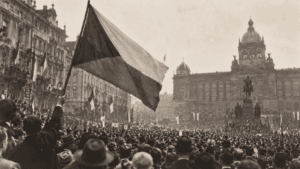
One of the most important locations during the events of 28 October was Wenceslas Square, where news of the political changes quickly spread among the population. People gathered in the streets, flags appeared on buildings and public spaces, and Prague began to look completely different within a matter of hours.
The events were not confined to political offices and government buildings. Ordinary people became part of the historic moment, filling Prague’s streets and squares as they celebrated the end of Habsburg rule and the emergence of a new state.
Shortly before noon, four members of the National Committee – Alois Rašín, Antonín Švehla, František Soukup and Jiří Stříbrný – went to the Governor’s Office to announce that the National Committee was taking over public administration. The Governor, Max Coudenhove, was not in Prague, so they negotiated with his deputy, Jan Kosina.
The representatives of the National Committee informed him that the committee was assuming control of public administration while existing laws and regulations would remain temporarily in force. This decision was important because it allowed the transition to a new state to take place without bringing everyday administration to a halt.
The Men of 28 October and the Transfer of Power
The four politicians who represented the National Committee on 28 October became known as the “Men of 28 October”– Alois Rašín, Antonín Švehla, František Soukup and Jiří Stříbrný. Vavro Šrobár, who played an important role in the creation of the new state, is also closely associated with these events.
That evening, the National Committee issued the first law of the new state. It confirmed the establishment of an independent Czechoslovak state and stipulated that existing laws and regulations would temporarily remain in force to ensure a smooth transition.
This was more than a symbolic declaration. The new country had to continue functioning from the very first day of its existence. Government offices, transportation, food supplies, public services and other institutions all had to continue operating while political power was transferred from the old imperial administration to the new Czechoslovak authorities.
Wenceslas Square and the Birth of a New State
Today, it can be difficult to imagine the atmosphere that filled Wenceslas Square on 28 October 1918. The square, which is now one of Prague’s best-known landmarks, became a place where thousands of people gathered to witness a historic transformation.
There were no social media platforms, online news sites or smartphones to spread information instantly. Instead, news travelled through newspapers, public announcements, crowds and word of mouth. Yet the information about the dramatic political changes spread remarkably quickly.
For the people of Prague, the creation of Czechoslovakia was not simply a distant political event. It could be seen and felt in the streets around them. Flags changed, imperial symbols disappeared and public spaces became places of celebration.
This is one of the most fascinating aspects of 28 October 1918 in Prague: history was not taking place somewhere far away. It was happening directly in the city, among ordinary people going about their daily lives.
From Austria-Hungary to Czechoslovakia
The proclamation of an independent Czechoslovak state on 28 October 1918 marked the end of centuries of Habsburg rule over the Czech lands. At the same time, the creation of the new state was part of a much broader political process that had developed during the First World War.
The Czechoslovak independence movement abroad played a particularly important role. Tomáš Garrigue Masaryk, Edvard Beneš and Milan Rastislav Štefánik worked to gain international recognition for the idea of an independent Czechoslovak state.
On 18 October 1918, Masaryk issued the Washington Declaration, formally declaring the independence of the Czechoslovak nation. Meanwhile, events in Prague were creating the foundations for the domestic administration of the new state.
The events of 28 October therefore represented an important combination of domestic political action and international diplomatic efforts. The new state was being established both in Prague and on the international stage.
What Happened in Prague After Independence Was Declared?
One of the immediate priorities of the National Committee was to maintain order throughout the city. The collapse of Austria-Hungary created a potentially unstable situation, and the new authorities needed to ensure that public administration, food supplies and essential services continued to function.
Members of the Sokol movement and other organised groups helped maintain order in Prague. At the same time, imperial symbols were removed from public spaces and replaced with Czech and Czechoslovak symbols.
Although the events of 28 October are often described as a revolution or political takeover, the transfer of power in the Czech lands took place without a large-scale armed confrontation. Maintaining order and preventing violence was an important concern for the representatives of the National Committee.
This peaceful transition, however, should not obscure the fact that the creation of Czechoslovakia was the result of a much longer political, diplomatic and military struggle that had taken place both at home and abroad.
Why Do We Still Remember 28 October?
The Independence Day of Czechoslovakia commemorates the moment when a new state of Czechs and Slovaks emerged following the First World War. Although Czechoslovakia would later experience dramatic changes, including the Nazi occupation, the Communist takeover and ultimately the peaceful dissolution of the federation in 1993, 28 October 1918 remains one of the key dates in modern Czech history.
Today, 28 October is a Czech public holiday officially known as Independent Czechoslovak State Day. It is an opportunity to remember the creation of Czechoslovakia and to reflect on the political and social changes that shaped the history of the Czech lands during the twentieth century.
For Prague in particular, the date has a special significance. The city was at the centre of the events, and many of the places associated with the birth of the new state are still part of Prague’s everyday landscape.
28 October 1918 in Prague: History Is Still All Around Us
Perhaps the best way to understand the importance of 28 October 1918 is to explore Prague itself. Places that seem completely ordinary today were once the backdrop to events that changed the future of an entire country.
Wenceslas Square, the Old Town, historic government buildings and many other locations across Prague were connected with the events surrounding the birth of Czechoslovakia. Walking through the city today means walking through the same streets where people experienced the dramatic events of October 1918.
And this is exactly what makes Prague’s history so fascinating. The past is not limited to dates and names in a history book. It can be found in the buildings, squares and streets around us.
At Story of Prague, you can discover the city’s history through the people, stories and events that shaped it. If you are visiting Prague around 28 October, it is an ideal opportunity to look beyond the city’s famous landmarks and discover the stories behind them – including the extraordinary day when Prague became the centre of the birth of Czechoslovakia.