








21 August 1968: The Shock of the Soviet Invasion That Changed Czechoslovakia
When people woke up on 21 August 1968, tanks were already moving through the streets, military aircraft were flying overhead and radio broadcasts were reporting events that many listeners initially found almost impossible to believe. Czechoslovakia was being occupied by armies led by the Soviet Union, and the period known as the Prague Spring had suffered a devastating blow within just a few hours.
For visitors to Prague today, it is difficult to imagine Wenceslas Square filled with tanks instead of tourists, or Vinohradská Street covered in smoke as people fled from gunfire. Yet 21 August 1968 was one of those moments when familiar Prague streets suddenly became the setting for one of the most dramatic chapters in modern Czech history.
The Prague Spring: A Few Months of Hope
To understand the shock of the August invasion, we need to go back several months. At the beginning of 1968, Alexander Dubček became First Secretary of the Communist Party of Czechoslovakia and a reform movement began to transform the country.
Public debate became more open, censorship was relaxed and newspapers, artists and ordinary citizens were suddenly able to discuss subjects that had previously been considered taboo. People talked about the political trials of the 1950s, economic reform and greater personal freedom, and the period soon became known around the world as the Prague Spring.
Czechoslovakia was not planning to abandon socialism or leave the Eastern Bloc. Dubček and his supporters wanted to reform the existing system from within and create a more open form of socialism, famously described as “socialism with a human face”.
For the Soviet leadership, however, these changes were becoming increasingly dangerous. Moscow feared not only losing control over Czechoslovakia, but also the possibility that similar reforms might spread to other countries within the Eastern Bloc.
The Night the Tanks Crossed the Border
Late on 20 August 1968, the main military operation began. Warsaw Pact forces crossed the borders of Czechoslovakia, while airports, communications networks, government institutions and media organisations quickly became strategic targets.
The Czechoslovak army was ordered not to offer armed resistance. Against the overwhelming military force entering the country, an organised military confrontation could have resulted in enormous casualties.
The scale of the invasion was massive. Within the following days, almost half a million troops were operating on Czechoslovak territory, with Soviet forces forming the core of the occupation army alongside units from other Warsaw Pact countries.
For ordinary people, however, the invasion was not about military numbers. It was the sudden and disturbing sight of tanks belonging to countries that communist propaganda had spent years describing as allies.
21 August 1968: Prague Wakes Up Under Occupation
One of the first key locations in Prague was Ruzyně Airport, now Václav Havel Airport Prague. During the night, Soviet forces secured the airport and used it to bring further troops and equipment into the capital, while armoured columns moved towards the city centre.
Thousands of people began gathering in the streets. Some tried to speak directly to the young soldiers, explaining that there was no counter-revolution or civil war taking place in Czechoslovakia. Others protested with Czechoslovak flags, banners and slogans against the occupation.
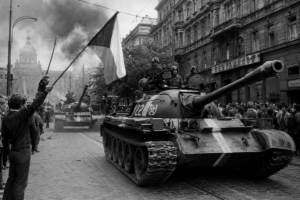
Radio broadcasts repeatedly urged people to remain calm because even a small violent incident could trigger further shooting. The contrast between everyday city life and heavy military machinery created some of the most iconic images of 1968: tanks in front of historic Prague buildings, crowds arguing with soldiers and Czechoslovak flags flying above streets filled with confusion, anger and disbelief.
The Battle for Czechoslovak Radio
One of the most dramatic locations on 21 August was the Czechoslovak Radio building on Vinohradská Street. Radio was enormously important because it provided people with up-to-date information and made it clear that the arrival of foreign troops had not been requested or approved by the legitimate Czechoslovak leadership.
Shortly before 2 a.m., listeners were already being informed that foreign troops had crossed the borders. As the morning continued, crowds gathered outside the radio building and Soviet armoured vehicles moved into the surrounding streets.
The situation soon escalated. Gunfire broke out and the area around the radio station became the scene of some of the heaviest casualties during the first day of the invasion.
Journalists continued broadcasting even as gunfire, tanks and chaos could be heard outside. Although the occupying forces eventually took control of the building, radio broadcasts continued from improvised locations elsewhere in Prague and became one of the most powerful symbols of non-violent resistance.
When you walk along Vinohradská Street today, only a few minutes from Wenceslas Square, it is difficult to imagine that people once stood here facing tanks while urgent broadcasts were transmitted across the country.
Tanks on Wenceslas Square
Wenceslas Square became another powerful symbol of the occupation. Today it is one of Prague’s busiest public spaces, but on 21 August 1968 it was filled with military vehicles, protesters and confusion.
Gunfire also struck the historic building of the National Museum at the top of the square. Soviet soldiers damaged its façade, sandstone columns and sculptural decoration, and traces of the shooting were later deliberately preserved during restoration work as a reminder of the events of 1968.
It is one of those places where history remains physically visible in the city itself. Visitors standing in front of the National Museum today are looking at the same building that appears in famous photographs surrounded by tanks and crowds during the invasion.
Resistance Without a War
The Czechoslovak army did not fight the invading troops, but that did not mean the population accepted the occupation.
Resistance was mainly civilian. People demonstrated, waved Czechoslovak flags, printed leaflets, painted anti-occupation slogans and tried to explain the real situation to confused soldiers. Street signs were sometimes removed or turned around to make navigation more difficult for the occupying forces.
This largely non-violent resistance became one of the defining features of the first days of the occupation. People wanted to make it clear that the foreign armies were not welcome, while also understanding that an armed uprising against Soviet military power would have little chance of success.
Despite repeated calls for calm, violence still occurred in many places. By the end of 1968, 137 people had died in connection with the occupation and around 500 had suffered serious injuries. Some of the worst casualties during the first day occurred around the Czechoslovak Radio building in Prague.
The End of the Prague Spring
Alexander Dubček and other leading figures of the reform movement were arrested during the invasion and taken to the Soviet Union. The negotiations that followed in Moscow marked a major turning point, and the reforms of the Prague Spring gradually began to be reversed.
Over the following months and years, Czechoslovakia entered the period known as Normalization. Many of the reforms were cancelled, people associated with the reform movement lost political positions and jobs, media freedom was once again severely restricted and large numbers of people chose to leave the country.
The Soviet military presence also did not disappear after the initial invasion. Around 75,000 Soviet troops remained permanently stationed in Czechoslovakia, and the last Soviet soldiers did not leave until 1991, more than twenty years after the events of August 1968.
You Can Still See the Traces of August 1968 in Prague
One of the most striking things about the events of 21 August is how many of the locations connected with the invasion are still easy to visit today. Wenceslas Square, the National Museum and the Czech Radio building on Vinohradská Street are ordinary parts of modern Prague, but they are also authentic locations from one of the most dramatic days in the city’s recent history.
That is why 21 August 1968 is much more than another date in a history book. It is the story of a city that woke up to a completely different reality within a matter of hours, of ordinary people standing in front of tanks with almost no ability to stop them, and of how quickly a period of hope can be replaced by fear, uncertainty and powerlessness.
When you walk through Wenceslas Square or along Vinohradská Street today, it is easy to pass these places without noticing their significance. But once you know their story, Prague begins to look different. Behind its familiar façades is a city that experienced the optimism of the Prague Spring, the shock of tanks in its streets and the determination of people who refused to accept occupation as something normal.