








The death of Ottokar II of Bohemia and the epic battles that shaped Czech history
Czech history is not only a story of kings, castles and crown jewels. Battles played an equally important role, and in many cases a single day on the battlefield decided who would sit on the Czech throne, which direction the country would take, or who would dominate the political landscape of Central Europe. Few rulers illustrate this better than Ottokar II of Bohemia, whose final battle changed both his fate and the future of the Czech lands.
The death of Ottokar II of Bohemia, one of the most powerful Czech rulers in history, became one of the most dramatic moments of the Czech Middle Ages. His story shows just how quickly a medieval monarch could fall from the height of European politics to a battlefield where he lost both his power and his life.
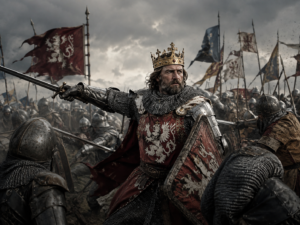
Ottokar II of Bohemia: the iron and golden king
In the second half of the 13th century, Ottokar II of Bohemia ranked among the most important rulers in Central Europe. At the height of his power, his influence stretched from the Czech lands through Austria and Styria towards the Adriatic, giving the Czech kingdom an exceptionally strong position.
Ottokar founded towns, built castles, supported trade and steadily expanded his territory. He achieved one of his greatest military victories at the Battle of Kressenbrunn in 1260, where he defeated the Hungarian king Béla IV.
His greatest rival, however, would eventually become Rudolf of Habsburg. In 1273, the prince-electors chose Rudolf as King of the Romans. Ottokar refused to recognise him, and the growing tension between the two rulers eventually developed into a conflict that would dramatically change the future of the Czech lands.
The battle on the Marchfeld, 1278: the king’s final battle
The decisive clash came on 26 August 1278 on the Marchfeld, in what is now Lower Austria. The armies of Ottokar II of Bohemia faced the forces of Rudolf of Habsburg, who fought alongside the troops of the Hungarian king Ladislaus IV.
For a long time, the battle remained evenly matched, but Rudolf’s reserves eventually attacked the flank of the Czech army and turned the course of the fighting. Ottokar’s forces began to collapse, and the Czech king died during the battle.
The exact circumstances of his death remain uncertain. Later accounts sometimes describe it as murder or an act of personal revenge, but historians cannot reliably reconstruct the final moments of Ottokar’s life. Modern historians also question the famous story of Milota of Dědice betraying the king and doubt whether any deliberate betrayal actually took place.
Ottokar’s death had enormous political consequences. His powerful realm quickly fell apart, while Rudolf of Habsburg greatly strengthened his position. Today, Ottokar II of Bohemia rests in St Vitus Cathedral at Prague Castle, where visitors can stand only a short distance from the tomb of a ruler whose ambitions once reached almost as far as the Adriatic Sea.
Vítkov and the Hussite Wars
More than a century later, the Czech lands were shaken by the Hussite Wars. One of the first important clashes was the Battle of Sudoměř in 1420, where Hussite forces led by Jan Žižka used the landscape and their war wagons to defeat a larger enemy.
An even more important battle for Prague took place on Vítkov Hill in July of the same year. A crusading army led by Sigismund of Luxembourg attempted to seize the strategically important hill and tighten its siege of the city. The Hussites managed to repel the attack and helped save Prague from complete encirclement.
Today, Vítkov is best known for the monumental equestrian statue of Jan Žižka and its sweeping views over Prague. It is also a place where, more than six hundred years ago, the fate of Hussite Prague was genuinely at stake.
The Hussite Wars continued for many years, and their radical phase ended only with the Battle of Lipany in 1434. This time the conflict was not between Hussites and foreign crusaders, but between Czech factions themselves. The defeat of the radical Hussites opened the way to political compromise and brought the long conflict closer to an end.
Mohács, 1526: the battle that brought the habsburgs to the Czech throne
Some battles changed Czech history even though they took place hundreds of kilometres from Prague. The Battle of Mohács is one of the clearest examples.
In August 1526, the Ottoman army defeated the forces of the young King Louis II of Bohemia and Hungary. Louis died while retreating from the battlefield and left no heir. The Bohemian Estates later elected Ferdinand I of Habsburg as King of Bohemia, beginning a long period in which the Habsburg dynasty closely influenced the Czech lands.
A battle fought in what is now Hungary therefore had a profound impact on the political future of Prague and the entire Czech kingdom.
White Mountain, 1620: two hours that changed the Czech lands
Few battlefields carry as much symbolic weight in Czech history as White Mountain. On 8 November 1620, the army of the Bohemian Estates confronted the combined forces of the Holy Roman Emperor and the Catholic League on the western edge of Prague.
The battle lasted only around two hours, but its consequences shaped the Czech lands for generations. The Bohemian Revolt quickly collapsed, Frederick V fled Prague, and the Habsburgs significantly strengthened their control over the country.
People sometimes describe White Mountain simply as a battle between Czechs and foreigners, but the reality was far more complicated. Soldiers of different nationalities fought on both sides, while religion, politics and dynastic interests all played crucial roles.
Today, visitors to Prague can easily explore the historic battlefield, which now forms part of the modern city.
Hradec Králové, 1866: the largest battle fought on Czech soil
By the 19th century, warfare had changed completely. Medieval knights had given way to mass armies equipped with modern rifles and artillery, while railways could move thousands of soldiers at unprecedented speed.
On 3 July 1866, Austrian and Saxon forces clashed with the Prussian army near Hradec Králové. Hundreds of thousands of soldiers took part, making it the largest field battle ever fought in the Czech lands.
The Prussian victory weakened Austria’s position and helped reshape the political balance of Central Europe. Even today, the countryside around Hradec Králové is dotted with memorials and war graves, giving parts of the area the atmosphere of a vast open-air museum.
Zborov and the fight for a future Czechoslovakia
Another important battle took place during the First World War. At the Battle of Zborov in 1917, Czechoslovak Legionnaires achieved a significant victory over Austro-Hungarian forces.
Although Zborov was not one of the largest battles of the war, its political impact proved far greater than its military significance. The victory strengthened the reputation of the Czechoslovak resistance abroad and became an important symbol of the struggle for an independent Czechoslovak state, which was established the following year.
Prague, 1945: when the streets became a battlefield
The final major chapter of this story unfolded directly in Prague at the end of the Second World War. On 5 May 1945, the Prague Uprising began, and within hours fighting had spread across the city.
The insurgents fought to control the radio station, bridges, railway stations and other strategic locations. Meanwhile, Prague residents built hundreds of barricades throughout the city. The resistance included not only organised fighters but also ordinary citizens who joined the struggle against German occupation.
Today, memorial plaques and monuments across Prague commemorate these events. Visitors can walk along streets filled with cafés, trams and tourists without realising that fierce fighting took place there only a few generations ago.
The battles after which Czech history was never the same
From the Marchfeld and Vítkov to White Mountain, Hradec Králové and the Prague Uprising, Czech history repeatedly changed in the space of just a few hours on the battlefield. Ottokar II of Bohemia lost his power and his life, the Hussites helped defend Prague, Mohács opened the Czech throne to the Habsburgs, and White Mountain reshaped the political and religious future of the country.
Prague is one of the best places to discover these stories today. At Prague Castle, you can visit the final resting place of Ottokar II of Bohemia, look out over the city from the site of the Hussite victory on Vítkov Hill, and walk across the battlefield of White Mountain, where the future of the Czech lands was decided more than four centuries ago.
Story of Prague presents history in exactly this way — not as a list of dates, but as the story of real people, great ambitions, dramatic decisions and events whose consequences can still be felt throughout the city today.